![]() |
![]() |
![]() |
![]() |
![]() |
![]() |
![]() |
![]() |
![]() |
![]() |
|||||||||||||
|
|
||||||||||||||||||||||
|
|
|||
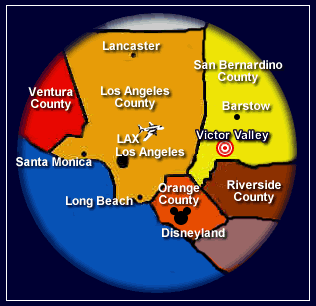
The 75-Mile Circle: The Victor ValleyA 75-mile circle surrounding Los Angeles encompasses the Victor Valley region of Southern California’s Inland Empire. Professional Land Corporation has a diverse inventory of prime Southern California properties in a multitude of locations, including the fabulous Victor Valley, and other Inland Empire locations that lie outside of the Victor Valley, such as Barstow and the surrounding communities. The Inland Empire The Inland Empire consists of San Bernardino and Riverside Counties. The U.S. Commerce Department has predicted that the Inland Empire, which lies next to Orange, Los Angeles and San Diego Counties, will outperform the growth rate of any other area in the United States. Furthermore, the California Department of Finance has predicted that the Inland Empire in the next decade will be the fastest growing urban area of California. | |||
| THE INLAND EMPIRE IS RANKED NO. 3 IN THE NATION FOR JOB CREATION IN 2007 | |||
According to the San Bernardino Sun, September 26, 2007, the Miliken Institute conducted a two-year study on job creation and retention and rated the Ontario-San Bernardino-Riverside area (“Inland Empire”) as No. 3 among 200 large U.S. metropolitan areas, which beats its No. 10 national ranking in 2005.The Inland Empire was the only California region in the nation’s top 15. "This study shows that this area is an economic powerhouse, and will remain one for the next several decades," Ontario City Manager Greg Devereaux said. "This area is Orange County from 20 years ago on steroids or like Phoenix, but at an exponentially higher level. “
"The Inland Empire has consistently been one of the national leaders in job growth," said Ross DeVol, director of regional economists at the Milken Institute and primary author of the report. The Inland Empire has been helped in job creation by the surge of over 129,000 workers with university credentials who have moved to the region. This has brought high-income consumers to the region, which has contributed to the Inland Empire becoming an economic powerhouse. The Milken Study further pointed that the area has shown the ability to overcome the high costs of doing business in California." Moreover, the Report cited L.A./Ontario International Airport as a major reason for the surge, particularly in that it links the area to Asia as a trading partner. The Study also pointed to the growth of Indian Casinos in the Inland Empire. Lower home prices have been a big advantage for the Inland Empire, but that gap has narrowed. “The area also has become a real international trade hub. In addition, there have been a lot of high-tech companies moving to the Inland Empire." Gloria Gonzalez-Rivera, chairwoman of the economics department at UC Riverside, said that the sharp increase in population has been an important factor in the area's growth. "When you get that many people in an area, the jobs come with them," she said. "People see that they do not need to go to Los Angeles to work or to consume. With high gas prices, people start to feel that if they're going to work in L.A., their salary needs to be much higher." Moreover, the residents of the Inland Empire shop and expect services in their backyard, and then shopping centers naturally have followed and have satisfied the demand. | |||
| THE CALIFORNIA DEPARTMENT OF FINANCE PREDICTS THAT THE INLAND EMPIRE WILL BE THE FASTEST GROWING AREA IN CALIFORNIA | |||
According to the Economist, John Husing, in his Report for the year 2000, the CA Department of Finance has predicted that the Inland Empire in the next decade will be the fastest growing urban area of California. The Inland Empire is projected to add 1.1 million more people by 2010, a 34.2% growth rate. That would represent an average gain of 110,121 per year. As a result, the 2010 population would reach 4,310,000.
According to OC Metro Magazine, February 2, 2006, the Inland Empire added 567,676 residents in the five year period 2000-2005, swelling the population of that Region to a staggering 3.9 million. | |||
| THE U.S. COMMERCE DEPARTMENT HAS PREDICTED THAT THE INLAND EMPIRE WILL OUTPERFORM THE GROWTH RATE OF ANY OTHER AREA IN THE UNITED STATES | |||
The U.S. Commerce Department has predicted that the Inland Empire, which lies next to Orange, Los Angeles and San Diego Counties, will outperform the growth rate of any other area in the United States.
According to the Economist, John Husing, in his Report for the year 2005, between the years 2000-2020, the Inland Empire’s population is expected to go from 3.2 million to 5.0 million, up 1.8 million. That is more people than will be added by 47 of the Nation’s 50 states. The exceptions are California (12.8 million), Texas (5.6 million), and Florida (4.4 million). Moreover, the Region is expected to add just a few less people than Los Angeles County (1.9 million) and more than San Diego, Orange, Ventura and Imperial counties combined (1.6 million). As a separate state, the Inland Empire's July 2004 population of 3.8 million was above 24 states, having just passed Oregon (3.6 million), Oklahoma (3.5 million) and Connecticut (3.5 million). According to the U.S. Commerce Department, the Inland Empire had $84 billion in total personal income during 2002, which was higher than Iowa and more than 21 other states in the U.S.A. This Inland Empire has become a tornado of economic activity and job creation with hundreds of companies moving into the area or expanding their operations in the last three years. Many of them have relocated from Los Angeles, San Diego and Orange Counties. According to the Inland Empire Quarterly Economic Report, April 2005, the Inland Empire is projected to add 40,100 jobs in 2005, which would bring the Region’s employment total to 1,208,633 in 2005. |
|||
| FIVE WAL-MART SUPERCENTERS ARE PLANNED FOR THE INLAND EMPIRE’S VICTOR VALLEY | |||
According to the Victorville Daily Press, January 20, 2008, five Wal-Mart Supercenters are expected to open in the Victor Valley portion of the Inland Empire over the next two years. Three stores are proposed for Victorville, one for Apple Valley and one for Hesperia. These Supercenters are expected to nearly double the size of a regular Wal-Mart and sell food, including fresh produce. Each store is expected to generate $750,000 per year in local tax revenues according to John Mendez, spokesman for Wal-Mart in Southern California.
Wal-Mart already has regular discount stores in Apple Valley and in Victorville, as well as a distribution center in Apple Valley. The chain’s interest in expanding came from a combination of population growth and requests from customers for more stores. With the addition of the Supercenters, High Desert residents may see prices drop at other major grocery stores. Here are the five planned Supercenters: Victorville: In Victorville, at the Dunia Plaza Shopping Center on Bear Valley Road and I-15, there is planned a Wal-Mart Supercenter combined with a Sam’s Club, as well as three additional parcels for future development. The entire project is expected to employ 720 people on a 33-acre retail site. The Wal-Mart portion will be 231,000 square feet and include an in-store and drive-through pharmacy, a garden center and an auto center. The second proposed Victorville store would be near the corner of Palmdale Road and Highway 395. The third would be on Ridgecrest, near Spring Valley Lake. Wal-Mart is conducting environmental reviews at the sites. City officials are expecting approval later this year, which would mean a possible opening of late 2009 or early 2010. Apple Valley: The proposed Apple Valley store would be on the southeast corner of Highway 18 and Dale Evans Parkway, between Thunderbird Road and Civic Center Park. The 260,000-square-foot project is scheduled to be reviewed by the town's Planning Commission in early 2008, according to the town’s Web site. Hesperia: The Hesperia store will be on the corner of Main Street and Escondido Avenue. Wal-Mart is finishing their environmental review there, said city spokeswoman Kim Summers. She anticipates the project will be approved and they are expected to break ground this fall. |
|||
| CHINESE COMPANIES ARE COMING TO THE INLAND EMPIRE NORTH IN 2007 | |||
According to the Inland Empire Business Press, July 7, 2007, Chinese companies are setting up shop in the Inland Empire in the wake of a Chinese government program that helps corporations establish overseas operations. Despite the challenges, more than 300 Chinese companies have located in the Los Angeles and Inland Empire areas over the past five years. More are coming. The number of Chinese companies setting up shop in the United States is increasing as the result of an incentive program created by the Chinese government two years ago.
The Chinese manufacturer, United Plastics, will begin operating a 50,000-square-foot plastic extrusion factory in Barstow in mid July 2007, according to John Rader; Barstow’s Public Information Officer. The $6 million factory will produce 45 new jobs. The factory manufactures plastic eating utensils and foam containers. In addition, approximately 50 Chinese companies have applied for visas to establish stores at the Barstow Outlets on Mercantile Way. Most are from the city of Yiwu, known as a commodities center in China. The Barstow Planning Commission in September 2005 approved a request from China Factory Direct Inc. for 100 Chinese retail manufacturers to open stores in 80,000 square feet of space at the Barstow Factory Outlet Mall. The deal allows the retailers to sell wholesale and retail goods, but requires warehousing in locations zoned for industrial uses. China Factory Direct has offices in the Chinese cities of Yiwu, Wenzhou and Shanghai. The company helps Chinese businesses acquire visas to operate in the United States, obtain business licenses and other activities. The Yasheng Group acquired 81-acres at Kramer Junction. Kramer Junction is located at the junction of U.S. Highway 395 and California Highway 58. Highway 395 can be taken from San Diego to Northern California, and Highway 58 leads to Barstow and Bakersfield, connecting easterly to the I-15 interchange to Las Vegas and westerly to the 14 and 5 Freeways. According to the Victorville Daily Press, May 7, 2006, Yasheng proposes a $100 million global distribution center at Kramer Junction with an projected annual payroll of $2.67 million. Yasheng is a diverse conglomerate with products ranging from sodium sulfite to plastic industrial pipe to hops (it claims to supply the most hops to beer-makers in China), said Michael Larivee, General Manager of the Company’s United States operations. The proposed project is planned in three phases. First, Yasheng plans to build a logistics center for its own use, including a dry storage palletized area as well as a controlled-temperature and bulk-staging area for repacking and labeling. The second phase will involve an expansion of the first phase, and the third phase will involve offering logistics services to other companies — both from the U.S. and China. “The reason they chose the location at Kramer Junction is because it was close to the Southern California Logistics Airport.” The Chinese Company plans to use SCLA for imports and exports, providing a direct link between the High Desert and China. The 24-hour U.S. Customs office at SCLA would help companies bypass the congestion in Los Angeles and Ontario. However, before the Project can begin, it will require the construction of a rail spur to connect with the main tracks. As of July 2007, YaSheng and their Chinese Partners discussed the Project and land uses with Paul Herrera, Communications Coordinator for the San Bernardino County Economic Development Agency. |
|||
| SAN BERNARDINO COUNTY ASSESSED PROPERTY VALUES HIT A NEW RECORD HIGH FOR THE FISCAL YEAR 2005-2006, LED BY VICTOR VALLEY CITIES | |||
According to the Victorville Daily Press, July 9, 2005, the assessed value of property in San Bernardino County for the fiscal year 2005-06 rose by 14.5 percent to $126.5 billion, according to figures released July 8, 2005 by the San Bernardino County Assessor's Office. San Bernardino County encompasses the largest geographical area of the Inland Empire’s two counties. The countywide $15.9 billion increase for the 2005-06 fiscal period marks the largest assessed value growth in the county's history and has been the largest percentage increase in 15 years, Assessor Williamson said. "San Bernardino County continued to profit by the strong economic growth in the area. We are fortunate to live in a county with a diversified economic base and a unique quality of life."
The cities of the Victor Valley portion of San Bernardino County led the pack in these increases. Adelanto had the largest roll increase, rising 31.2 percent, which makes it the County’s fastest developing city. Victorville and Hesperia followed closely with increases of 28.6 percent and 25.8 percent respectively. Apple Valley experienced an increase of 18.5 percent. Assessed valuations in the city of Barstow increased 5.3 percent. While Barstow is not located in the Victor Valley, it is part of the Inland Empire. | |||
| ONTARIO HAS BECOME A POWERHOUSE IN THE INLAND EMPIRE | |||
Ontario International Airport has emerged as a powerhouse among Southern California Airports for its cargo and passenger services. According to Airport World Magazine, February/March 2003, Ontario International Airport is listed among "six of the best" air cargo airports on the planet, and is ranked among the fastest growing and ambitious cargo airports outside of the thriving Asia-Pacific market. Airport World is the official magazine of the Airports Council International that has over 535 international airports and airport authorities in its jurisdiction, running over 1,400 airports in more than 165 countries.
According to the International Airport Website, Ontario International Airport offers passengers commercial jet service to major U.S. cities with connecting service to many international destinations. Ontario International Airport services a population of six million people that live in San Bernardino County, Riverside County, North Orange County and East Los Angeles County. Passenger traffic at Ontario International Airport has been increasing steadily for the past 10 years. Ontario International Airport’s Airlines include AeroMexico, Alaska, American Airlines, Continental, Delta, JetBlue, Lineas Aereas Azteca, Southwest, United, US Airways, and now ExpressJet. According to the San Bernardino Sun, February 6, 2007, a major expansion of passenger services at Ontario International Airport was announced by Airport Officials. According to L.A. Mayor, Antonio Villaraigosa, ExpressJet will offer 29 new nonstop flights out of Ontario International Airport to 14 destinations across the Nation. Between April 2, 2007 and May 14, 2007, Houston-based ExpressJet will introduce 29 nonstop daily flights to many cities, including Albuquerque, Boise, Kansas City and Monterey. Nonstop flights to Omaha and Tulsa will be the only such flights from any airport in Southern California, including LAX. The new service marks a 25 percent increase in daily departures from ONT and a 63 percent increase in the number of nonstop destinations served by the Airport. It is the largest expansion of air service in Ontario International Airport’s 84-year history, according to Los Angeles World Airports, which operates LAX, Ontario International Airport, Van Nuys and Palmdale Regional Airports. The new services will create 180 new jobs for the local economy, L.A. Mayor, Antonio Villaraigosa said. According to the San Bernardino Sun, March 11, 2003, the City of Ontario emerged as the Inland Empire's powerhouse in retail sales according to the 2001 State Board of Equalization Report on Taxable Sales in California. Ontario had a staggering $3.62 billion in taxable sales. Thanks largely to the Ontario Mills Shopping Mall and strong automobile sales, Ontario had $2.464 billion in sales at retail stores and $3.62 billion at all outlets. Jack Kyser, the chief economist with the Los Angeles County Economic Development Corporation, compared Ontario to retail powerhouses such as Costa Mesa and Beverly Hills. Costa Mesa's numbers in particular ($2.473 billion from retail stores, $3.16 billion overall) are very similar to Ontario's. |
|||
| THE INLAND EMPIRE IS THE NATION'S STRONGEST APARTMENT MARKET | |||
According to the San Bernardino Sun, March 21, 2003,
the Inland Empire topped the list in Marcus & Millichap's 2003 National Apartment
Index, a study that rates the health of 40 apartment markets nationwide. The report
is based on a series of 12-month, forward-looking supply-and-demand indicators,
including employment growth, vacancy rates, construction, housing affordability and
rent growth. According to the index, the Inland Empire has an expected rent growth of
4.5 percent for 2003, which is the highest among the 40 markets studied in the
United States. This year's vacancy rate for the Inland Empire is 3.5 percent and
falling. Employment growth is listed at 1.9 percent. "When we look at employment and
the lack of new apartments, suddenly all the stars are in alignment,' said Steve
Johnson, director of Metrostudy Corp., a Riverside-based real estate consulting firm.
"Our area should be a very attractive target for the
Nation’s apartment builders.' San Bernardino and Riverside counties have emerged as the West's
strongest rental market with a 6% increase from the same period last year.
According to the San Bernardino Sun, January 22, 2004, the Inland Empire’s
apartment rents grew 6.4% in 2003 and showed the highest increase on a
percentage basis of any other region in the Western United States. The metropolitan
areas surveyed were in California, Washington, Colorado, Nevada, Oregon, Arizona,
Idaho, Utah and New Mexico. Rents in Los Angeles, Orange and San Diego
counties lagged the Inland Empire’s 6.4% increase and rose only from 3.3 percent to
4 percent, the study said.
|
|||
| THE INLAND EMPIRE IS THE NATION'S STRONGEST HOUSING MARKET | |||
According to the San Bernardino Sun, February 12, 2004, the Inland Empire's San Bernardino and Riverside counties registered the strongest rate of appreciation in the U.S.A. during the fourth quarter of 2003. "It's absolutely amazing what is happening. Every quarter is outdoing the previous one," said the owner of Riverside-based GMAC Park Place Realty. During the fourth quarter, the median price of an existing home in the Inland Empire reached $239,400, an increase of 28.9 percent from the comparable period a year earlier, the National Association of Realtors reported. The Inland Empire beat out Sarasota, Fla., to claim the national title for price appreciation. Median prices of existing homes in Sarasota jumped 26.1 percent to $222,100, the survey of 127 metropolitan areas found. The $239,400 median price is nearly $70,000 above the national median of $171,600. But John Husing, a Redlands-based regional economist, said that even with its increases, the local median is far below both the state median of $391,680 and the medians of neighboring coastal counties. "One of the reasons our prices are climbing so rapidly is because of a tremendous demand from people who can't afford to live in the coastal counties." With Orange County the second-most expensive in the nation at $526,800 and San Diego County third at $456,700, the two-county region still looks comparatively cheap.
|
|||
| INC. MAGAZINE NAMES THE INLAND EMPIRE THE NUMBER 2 BEST METRO AREA FOR BUSINESS IN THE U.S.A. | |||
According to the San Bernardino Sun, 2-10-04, Inc. Magazine has named the Inland Empire (San Bernardino/Riverside metro area) as the nation's second best large metro area for business. Despite California's budget crisis, high workers' compensation rates and high-energy costs, the two-county area edged
out Las Vegas, San Antonio and West Palm Beach, Fla.,
which are the cities that round out the top five. Atlanta
came out on top. Orlando and Phoenix ranked 11 and 12,
respectively, while San Diego placed 15th in the survey.
The Magazine based its findings on a review of job growth
data in 277 cities. "San Bernardino/Riverside Counties
(the Inland Empire) have consistently been on top of job
growth (in the state) for years. The decline in the stock
market really didn't affect it. Since 1990, more than 600,000 people have moved into the area, many of them minorities. "Such growth provides business opportunities for entrepreneurs," the article said. Michael Bazdarich, senior economist for the UCLA Anderson School Forecast, said the Inland Empire Region benefits from its location next to the huge Los Angeles market. The Inland Empires reasonable cost-of-doing business and business-friendly local government gives local businesses a leg up on the competition, he said.
|
|||
| WHY IS THIS HAPPENING IN THE INLAND EMPIRE? | |||
The answer is jobs and housing.
During the 1990’s Southern California suffered a strong recession and many jobs were lost to other states. However, there was no period when the Inland Empire’s job creation stopped growing.
From 2000-2020, the Southern California Association of Governments forecasts that the Inland Empire will add 805,286 jobs. In this period, Los Angeles County is forecasted to grow by 918,741. However, the Inland Empire would add more jobs than the 747,238 expected in Orange, San Diego, Ventura and Imperial counties combined. In 2004, the Inland Empire added 49,092 jobs which equaled the gains in Orange & San Diego counties combined. Los Angeles added just 8,958. According to the 2005 Husing Report, the Inland Empire has been Southern California's absolute leader in job creation for the past thirteen years, exceeding second place San Diego County by 151,500. This job creation has been helped by the Region’s educational systems. The Inland Empire is the home to 27 colleges and universities, which produce an educated and highly skilled labor force. This will help the future labor force of the Region, and should continue to attract the interests of large corporations in the United States and worldwide for many years to come. This impressive labor force has contributed to Riverside and San Bernardino counties representing one-third of the Southern California housing market. When Data Quick started tracking the region 17 years ago, Riverside's and San Bernardino's slice of the regional homes sales activity was about half that size. In just the first two months of 2005, Inland Empire builders pulled building permits for 5,564 detached homes vs. 416 in Orange County, according to the Construction Industry Research Board. According to OC Metro Magazine, February 2, 2006, Economist, John Husing, says that today a third of the Inland Empire’s new homes are upscale. Today, many of the Region’s luxury homes are selling for $1,000,000 and up. Furthermore, according to OC Metro Magazine, February 2, 2006, sixty-two percent of Southern California’s industrial space under construction is in the Inland Empire. And according to Grubb & Ellis, the Inland Empire will remain one of the more robust warehouse and logistic market areas in the country moving into 2006. With 56 million square feet of retail, office and warehouse development under construction in 2005, of which 12 million has already been completed, the Inland Empire is poised to be the market leader in commercial real estate for years to come. The Inland Empire's land values have already become expensive. Commercially zoned vacant land already is priced at $25 per square foot or $1,089,000 per acre. For example, according to OC Metro Magazine, February 2, 2006, a 50-acre vacant land parcel across the street from Rancho del Chino Shopping Center in the City of Chino was in escrow for $25 a square foot or $54,450,000. Residential land values in many communities of the Inland Empire South have also gone through the roof. On the other hand, the Inland Empire North offers reasonably priced properties in a dynamic, growing Region. Professional Land Corporation specializes in well located land parcels in the Inland Empire North in the Victor Valley, and in Barstow and surrounding communities. Many of these properties are zoned residential, industrial or commercial. Prime acreage parcels can be purchased with affordable long term financing. Professional Land Corporation specializes in choice, close in land parcels in prime locations in the Victor Valley. Many of these properties are zoned residential, industrial or commercial. Prime acreage parcels can be purchased with affordable long term financing. |
|||
![]() |
|||
|
|
||||||
|
|
||||||
|
||||||
|
||||||